Bacteriostatic Water: A Peptide Reconstitution Protocol Guide
What is bacteriostatic water?
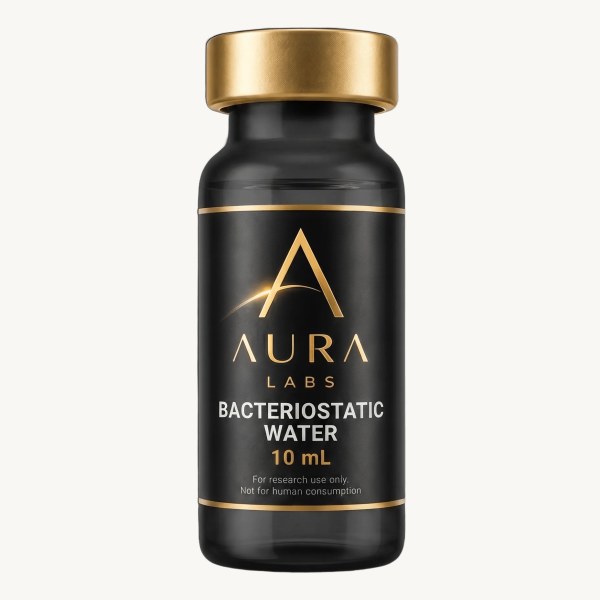
Bacteriostatic water is sterile water containing 0.9% benzyl alcohol as a preservative. The benzyl alcohol is bacteriostatic – it inhibits the growth of bacteria – which is what allows a reconstituted vial to be drawn from more than once over a period of days while remaining suitable for laboratory handling. This is the standard solvent used to reconstitute lyophilised research peptides, which arrive as a dry powder and must be dissolved before use.
How researchers use it
To reconstitute a peptide, bacteriostatic water is drawn into a syringe and added slowly down the side of the peptide vial, allowing the powder to dissolve gently without vigorous mixing. The volume of water added sets the final concentration – more water gives a more dilute solution and finer dosing control, less water gives a more concentrated one. Aura Labs’ reconstitution calculator works out the concentration and draw volume for any peptide and water amount. Because of its preservative, a vial reconstituted with bacteriostatic water can be stored and drawn from over a multi-day window, unlike plain sterile water.
Handling & storage
Store sealed vials cool and away from light. Keep a reconstituted peptide solution refrigerated and use it within the window appropriate to that peptide. Wipe the stopper before each draw, use a fresh needle, and avoid touching the needle or stopper surface, to keep the stock clean. Discard if the solution becomes cloudy or discoloured.
Why researchers choose Aura Labs
Aura Labs supplies research peptides and the reconstitution media that support them across Thailand, with quality-checked products and discreet, fast regional dispatch. Reliable bacteriostatic water is part of a reproducible research workflow.
Disclaimer
This product is provided for laboratory and research use only. It is not a drug, supplement, cosmetic or food, and is not intended for human or animal consumption or for any diagnostic or therapeutic use. All information here is for educational purposes and describes laboratory handling only.